Finally—it’s your turn.
After years of putting everyone else first, you’re entering a new chapter. The kids are more independent, whether they’re off to college, starting their first job, or finally moving out of the house. And while there’s definitely an emotional adjustment (hello, empty nest syndrome!), there’s also something else: newfound financial freedom.
According to research from the Center for Retirement Research at Boston College, empty-nest parents see their household spending decrease by about 6% relative to income. That’s not just a little wiggle room in the budget—that’s real money you can redirect toward your future.

But here’s the catch: studies show that parents only increase their 401(k) savings by 0.3 to 0.7 percentage points after kids leave home. That’s a missed opportunity, especially when you’re likely in your peak earning years and retirement is getting closer.
So let’s talk about how to make the most of this transition. Here are 10 strategic money moves that can transform your financial picture when the kids are more independent.
1. Supercharge Your Retirement Savings (Seriously, Go Big)
This is your moment. With fewer mouths to feed and college expenses wrapping up, you can finally prioritize retirement savings in a meaningful way.
The numbers for 2026:
- Standard 401(k) contribution limit: $24,500
- Catch-up contributions (age 50+): Additional $8,000
- “Super” catch-up (ages 60-63): Additional $11,250 instead of the standard $8,000
- IRA contribution limit: $7,500
- IRA catch-up (age 50+): Additional $1,100
That means if you’re 50 or older, you can potentially contribute up to $32,500 to your 401(k) and $8,600 to your IRA in 2026—that’s over $41,000 in tax-advantaged retirement savings for just one person.
Action step: Review your current contribution percentage and bump it up. Even increasing by 2-3% can make a significant difference over the next 10-15 years before retirement.
Pro tip: If you’re between 60-63 and your employer plan allows it, take advantage of that “super” catch-up contribution. It’s designed specifically for people in this critical pre-retirement window.
2. Kill That High-Interest Debt Once and For All
With more disposable income, now’s the perfect time to tackle any lingering credit card debt, personal loans, or other high-interest obligations. Carrying debt into retirement significantly impacts your cash flow and limits your lifestyle options.
Why it matters: Let’s say you’re carrying $10,000 in credit card debt at 20% interest. That’s costing you roughly $2,000 per year in interest alone—money that could be growing in your retirement accounts instead.
Action step: Create a debt payoff plan using either the avalanche method (paying off highest interest rates first) or the snowball method (paying off smallest balances first for psychological wins). The method matters less than the commitment to becoming debt-free.
3. Rebuild (or Build) Your Emergency Fund
Remember when you drained your emergency fund to help with college tuition or that unexpected home repair when the kids were still home? It’s time to replenish it—or create one if you never had the chance.
The magic number: Aim for 6-12 months of living expenses. As you get closer to retirement, lean toward the higher end. This cushion protects you from having to raid retirement accounts early or rack up debt when life throws curveballs.
Where to keep it: High-yield savings accounts are currently offering competitive interest rates. Your emergency fund should be easily accessible but separate from your everyday checking account.
4. Set Financial Boundaries with Adult Children
Here’s a statistic that might surprise you: nearly 40% of empty nesters still financially support their children, spending an average of $254 per month. The most common expenses? Cell phone bills, rent, groceries, and student loans.
While helping your kids is generous, it shouldn’t come at the expense of your retirement security. Remember: your children can borrow for college or their first home, but you can’t borrow for retirement.
Action steps:
- Have an honest conversation about expectations and timelines
- Consider setting a specific monthly budget for support (if any)
- Create a clear timeline for when financial support will phase out
- Teach your kids about budgeting and money management
The uncomfortable truth: According to the Milken Institute, many parents put significant money and effort into their children at the expense of their own futures and retirement. You’re not being selfish by prioritizing your financial security—you’re being smart.
5. Reevaluate Your Life Insurance Needs
Your life insurance needs at 25 with toddlers are vastly different from your needs at 50 with financially independent (or nearly independent) kids.
Questions to ask:
- Do you still have a mortgage that needs to be covered if something happens to you?
- Does your spouse rely on your income for living expenses?
- Do you want to leave a financial legacy?
- Are you still responsible for anyone’s college tuition?
Action step: Review your existing policies. If you have term life insurance that’s about to expire, decide whether to renew, reduce coverage, or let it lapse. If you still need coverage, this might be the time to explore permanent life insurance options that can also serve as a legacy tool.
6. Update Your Estate Plan (Yes, You Need One)
If you created a will when your kids were young, it likely names guardians who are now irrelevant and includes trusts designed for minors. Time for an update.
Must-review items:
- Will or revocable living trust
- Beneficiary designations on all retirement accounts, life insurance policies, and bank accounts
- Financial power of attorney
- Healthcare power of attorney and living will
- HIPAA authorization
Why this matters: Many women over 40 are at higher risk for “gray divorce” (divorce rates for those 50+ have roughly doubled since the 1990s). Whether married or single, having your estate plan updated ensures your wishes are honored and can prevent family conflicts down the road.
Action step: Schedule a consultation with an estate planning attorney. If you already have documents in place, review them every 3-5 years or after any major life change.
7. Audit Your Monthly Expenses and Subscriptions
You’d be amazed how many expenses linger from your kid-raising years that you no longer need.
Expenses to review:
- Cell phone plans (can you remove lines or switch to a cheaper plan?)
- Streaming services (do you really need all seven of them?)
- Gym memberships you haven’t used in months
- Life insurance on grown children
- College savings contributions if your kids are done with school
- Higher grocery bills (you can buy less now!)
The average savings: Many couples report freeing up $300-500+ per month just by trimming expenses related to kids who are no longer at home.
Action step: Do a 90-day spending audit. Track where every dollar goes and highlight expenses that are no longer serving your current lifestyle. Redirect that money to your priorities.
8. Consider Your Housing Situation
With 21 million empty nest households in the U.S., you’re not alone in reconsidering whether your current home still makes sense. About 30% of empty nesters decide to downsize.
Questions to ask:
- Is maintaining this large house worth the cost and effort?
- Could downsizing free up equity to boost retirement savings?
- Are you emotionally ready to leave the family home?
- Does your current location still fit your lifestyle?
Important caveat: Don’t rush this decision. Many financial experts recommend waiting at least 2-5 years after becoming empty nesters before making major moves. This gives you time to adjust emotionally and financially, and to avoid impulsive decisions.
Action step: If downsizing interests you, start exploring what’s available in your desired price range and location. Run the numbers on what you’d net from selling your current home (after paying off the mortgage, real estate commissions, and moving costs).
9. Invest in Yourself (Guilt-Free)
For years, your time and money went toward soccer practices, school supplies, and family vacations designed around the kids’ schedules. Now? It’s your turn.
Ways to invest in yourself:
- Take that trip you’ve always dreamed about
- Pursue hobbies or classes you put on hold
- Invest in your health with a gym membership, personal trainer, or wellness programs
- Start that side business you’ve been thinking about
- Reconnect with friends and build your social network
Why this matters: Studies show that 66% of empty nesters experience feelings of grief and loneliness. Investing in yourself—both financially and emotionally—helps combat empty nest syndrome and sets the foundation for a fulfilling retirement.
Action step: Build a “personal enrichment” line item into your budget. This isn’t frivolous—it’s essential for your wellbeing and happiness.
10. Get Professional Financial Advice
Here’s something many women don’t realize: if you’ve been married for years with combined finances, or if you’ve relied on a partner to handle money matters, becoming an empty nester is the perfect time to take ownership of your financial future.
Why now:
- Your financial picture is likely more complex than when you were younger
- Retirement planning requires careful coordination of multiple accounts and strategies
- Tax planning becomes increasingly important as you approach retirement
- Estate planning needs to align with your updated goals
What to look for in a financial advisor:
- Fee-only fiduciary (they’re legally required to act in your best interest)
- Experience working with women over 40 and empty nesters
- Comprehensive planning approach (not just investment management)
- Clear communication style that makes you feel comfortable asking questions
Action step: If you don’t currently work with a financial advisor, interview at least three candidates. If you do have an advisor, schedule a comprehensive financial review to make sure your plan reflects your current life stage.
The Bottom Line: This Is Your Time
The statistics are clear: women live longer than men (by an average of 5-6 years), which means we need more retirement savings. We’re also more likely to take career breaks for caregiving, resulting in lower lifetime earnings and smaller retirement accounts.
But here’s the good news: becoming an empty nester typically happens during your peak earning years, when you’re between 40-60 years old. If you play your cards right during this window, you can make up for lost ground and set yourself up for a secure, fulfilling retirement.
The transition to an empty nest isn’t just about what you’re losing—it’s about what you’re gaining. Financial freedom. Time for yourself. The ability to finally put your needs first.
So take a deep breath, feel all the emotions that come with this life transition, and then get to work building the financial future you deserve.
What’s Next?
The journey from raising kids to living your own life is both exciting and challenging. But with the right financial strategies in place, you can embrace this new chapter with confidence.
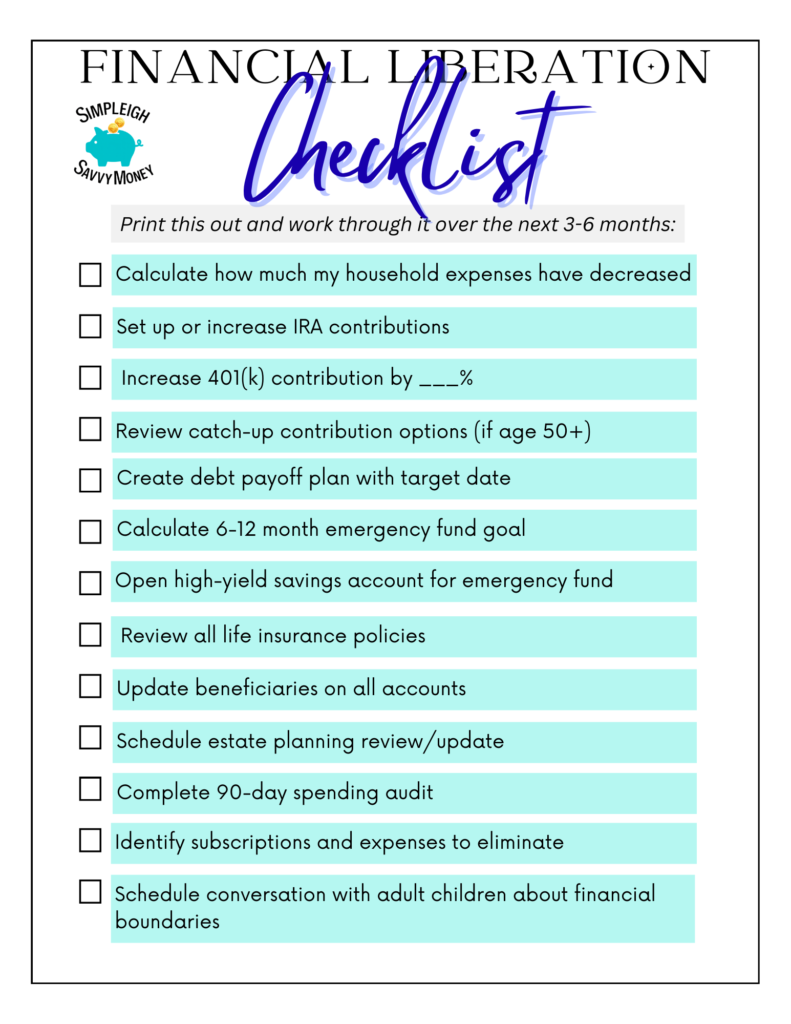
Download the FREE Financial Liberation Checklist Below:
Print the liberation checklist out and work through it over the next 3-6 months.
Which of these 10 money moves resonates most with you? Pick one to start with this week. Small, consistent actions add up to big changes over time.
Remember: You spent years taking care of everyone else. Now it’s time to take care of you.
Resources & Further Reading
- IRS Notice 2025-67: Official 2026 retirement contribution limits
- SECURE 2.0 Act: Understanding the new catch-up contribution rules for high earners
- AARP Empty Nest Financial Planning Guide
- Center for Retirement Research at Boston College: Empty Nester Studies
This article is for informational purposes only and should not be considered financial advice. Please consult with a qualified financial professional before making major financial decisions.