Stuck choosing a debt payoff strategy? We’re breaking down the popular Debt Snowball and Debt Avalanche methods with real-life examples—no finance degree needed. Find out which one fits your brain and your budget.
Let’s be honest: being in debt feels heavy. It’s like carrying a backpack full of bricks everywhere you go. You know you need to start unloading it, but staring at multiple debts—credit cards, student loans, a car payment—can make you feel so paralyzed that you do… nothing.

If that’s you, take a deep breath. You’re not alone, and more importantly, there is a clear path out.
Two popular, proven strategies have helped millions shed that weight: the Debt Snowball and the Debt Avalanche. Today, we’re going to walk through both of them, side-by-side, like we’re trying on two different pairs of shoes. We’ll figure out which one fits your personality, your money mindset, and your life.
Forget complex spreadsheets for a minute. This is about psychology as much as it is about math. Let’s find your win.
Meet the Contenders: A Simple Introduction
First, what do these methods have in common?
- Step 1: You make minimum payments on all debts (to avoid fees and damage to your credit).
- Step 2: You find any extra money in your budget—$50, $200, $500—and throw it all at one target debt.
- The difference is all about how you choose that target debt.
🥌 The Debt Snowball: The Quick Win Strategy
How it works: You list your debts from smallest balance to largest balance. You attack the smallest debt first with all your extra cash while making minimums on the rest. Once the smallest is gone, you take its payment and roll it onto the next smallest debt. The payment “snowball” grows as you go.
Why people love it: It’s all about momentum and motivation. You get quick victories, which feel amazing and prove to yourself, “Hey, I can actually do this!”
Example:
- Credit Card A: $500 (min $25)
- Medical Bill: $2,000 (min $50)
- Credit Card B: $6,000 (min $120)
You’d crush the $500 credit card first, then roll that $25 + your extra cash onto the $2,000 medical bill.
🏔️ The Debt Avalanche: The Math-Lover’s Strategy
How it works: You list your debts from highest interest rate to lowest interest rate. You throw all your extra cash at the debt with the highest APR (Annual Percentage Rate) first, while making minimums on the rest. Once it’s gone, you move to the next highest rate.
Why people love it: It’s the most mathematically efficient method. You pay less interest overall and get out of debt slightly faster, saving you real money.
Example:
- Credit Card A: $3,000 at 22% APR (min $90)
- Personal Loan: $5,000 at 6% APR (min $150)
- Student Loan: $10,000 at 4% APR (min $100)
You’d attack the 22% APR credit card first, even though its balance isn’t the largest.
Let’s Put Them Head-to-Head: A Real-Life Scenario
Meet Sarah. Sarah has three debts and an extra $300/month she can put toward her payoff plan.

| Debt | Balance | Interest Rate | Minimum Payment |
| Credit Card | $4,000 | 18% | $80 |
| Car Loan | $8,000 | 5% | $200 |
| Student Loan | $12,000 | 4% | $150 |
| Total Minimums | $430 |
Sarah will always pay the $430 in minimums. The question is, where does her extra $300 go?
If Sarah Chooses the Debt Snowball:
- Target Order: Credit Card ($4,000) → Car Loan ($8,000) → Student Loan ($12,000).
- The Win: She focuses on the credit card. She pays $380/month to it ($80 min + $300 extra). It will be gone in about 11 months. That feeling of closing that account? Priceless. She then rolls the $380 payment onto her car loan payment, now paying $580/month toward it.
If Sarah Chooses the Debt Avalanche:
- Target Order: Credit Card (18%) → Student Loan (4%) → Car Loan (5%). (Wait, the car loan has a higher rate than the student loan! See how order changes?)
- The Win: She also focuses on the credit card first because it has the highest rate. She pays it off in the same ~11 months. Mathematically, she will pay a little less in total interest over her entire debt journey because she always targets the highest rate next.
The NerdWallet Verdict: In most cases, the Avalanche saves you more money. But the difference might be smaller than you think—sometimes just a few hundred dollars over a few years. For Sarah, the psychological boost of the Snowball might be worth that small premium.
So, Which One Is Actually Best for YOU?
Let’s figure this out together. Ask yourself these questions:
You Might Be a Snowball Person If…
- You’ve started and stopped debt plans before.
- You need to see progress to stay motivated.
- The idea of closing an account quickly makes you want to do a happy dance.
- You find personal finance overwhelming and need simplicity.
- Your mantra: “I need wins to keep going!”
You Might Be an Avalanche Person If…
- The idea of “wasting” money on interest keeps you up at night.
- You’re detail-oriented and love a good spreadsheet.
- You have strong discipline and can stay motivated without quick wins.
- Your debts have wildly different interest rates (like 24% on a credit card vs. 3% on a student loan).
- Your mantra: “I want the mathematically optimal path.”
Still unsure? Here’s my heartfelt advice, especially if you’re feeling drained by debt:
If you have a history of giving up, choose the Snowball. A method you stick with is infinitely better than a “perfect” method you abandon.
Your Step-by-Step Starter Kit (For Either Method)
- Gather: List every single debt—balance, minimum payment, and interest rate. Use a notebook, a notes app, or our free printable tracker (link below).
- Order: Re-order your list based on your chosen method (smallest balance or highest rate).
- Budget Your “Extra”: Find your “debt demolition” money. Can you free up $50? $100? Use a spending tracker for one week—coffee, subscriptions, impulse Target runs—you’ll find it.
- Attack: Make minimums on everything. Throw every extra cent at your Target Debt #1.
- Celebrate: When you kill that first debt, CELEBRATE! Mark it in red, tell a supportive friend, and enjoy a (budget-friendly) treat. This is crucial.
- Roll: Take that debt’s full payment (minimum + extra) and add it to the minimum of your next target. Your payment power grows!
Bonus: The “Hybrid” Method (Because We’re All About Options)
Can’t decide? Mix them!
- Start with the Snowball to eliminate any tiny “nuisance” debts under $500. Get that quick momentum.
- Then, switch to the Avalanche for your larger debts, targeting the highest interest rates to save money.
It’s your plan. You make the rules.
A Final, Important Note on Self-Kindness
Whichever path you choose, please remember: debt is a financial situation, not a moral failing. You are not “bad with money.” You are a person who used credit to get through life—maybe through education, a tough time, or just the gradual creep of expenses.
This payoff journey is about forward motion. Some months you’ll crush it. Some months, a car repair will happen and you’ll only make minimums. That’s okay. The goal is to get back on the path, not to be perfect.
You are building your muscle of financial resilience. Every payment is a rep.
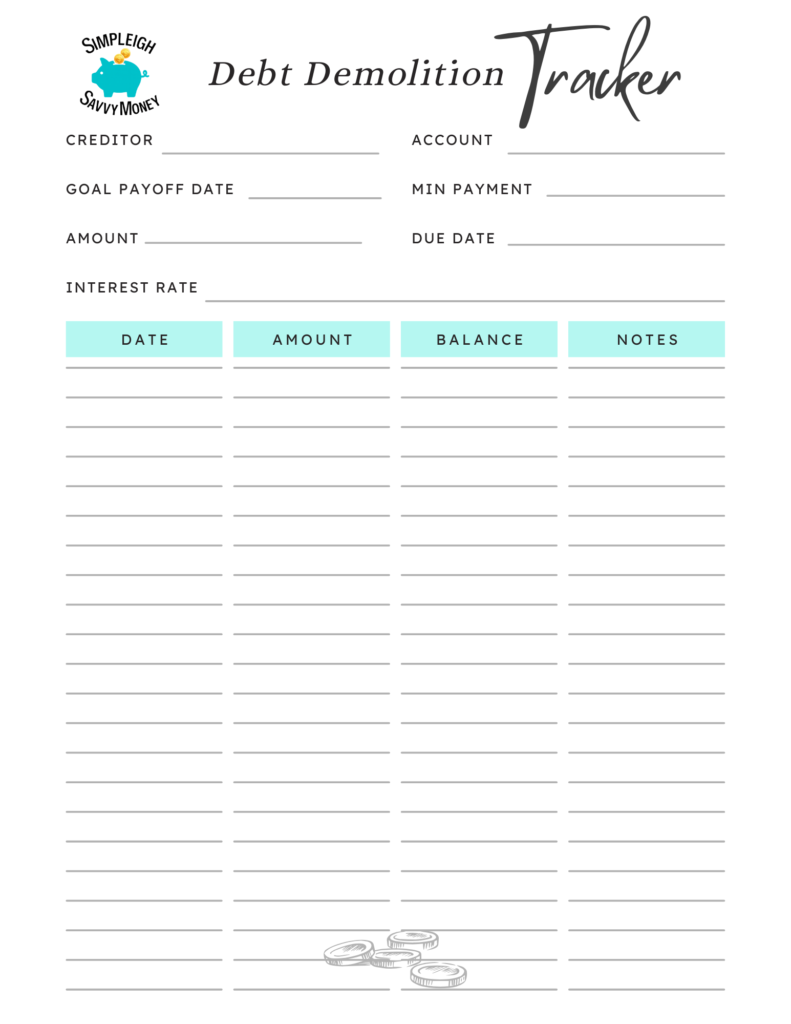
Download our free “Debt Demolition Tracker” printable! It’s a beautiful, simple sheet designed to help you list your debts, choose your method, and track your progress with satisfying check-offs. It makes the plan visual and real.
Let’s chat in the comments: Are you Team Snowball or Team Avalanche? What’s the first debt you’re going to tackle? Sharing your goal makes it more real—and we’re here to cheer you on!
Here’s to your lighter, brighter, debt-free future,
Laura Fields